When Xian, my aunt, contacted me on WeChat Sunday morning, I was still munching on my breakfast—two boiled eggs and a homemade avocado sandwich. Two days before, I had conducted the first interview through video call with Xian, and half way through it, my grandfather walked into Xian’s medicine store. I ended up doing a group interview with both of them. It was a bit chaotic, but lovely. With me nearly shouting on my end in my rusty Yiyang dialect and my aunt laughing and translating what I had said to my grandfather, I felt at home again. We had to end the talk when the patient that booked an appointment arrived. By the end of the first interview, I told Xian that I would need to schedule a second one with her. She later asked me on WeChat if she had answered all my questions well. I said she was the best possible interviewee one could ever find. She sent me two kissing emojis on WeChat.
I was half way through my sandwich when I saw Xian’s message — “Zaizai, are you free now? I can talk.” Zaizai is a term of endearment in my hometown dialect people frequently uses to call the youngest one in the family. Thinking I might as well finish an interview on time, I called her immediately.
My call rang for three seconds, and I saw my aunt sitting up from the lounge chair she had been lying in, smiling. Since it was already ten o’clock at night in China, I asked her whether it would be too late for an hour-long interview.
“No, it’s fine! I’m still not sleepy.” She fixed her hair and answered me in a high-spirited voice.
We picked up from the last interview where I was asking her to describe my paternal grandfather who had been a teacher to both my aunt and my maternal grandfather.
“He was very handsome, very tall, about six feet, and all the time well-dressed, looking very scholarly. He was teaching the ninth grade, but I’ve never had his class before.” Xian said.
I asked her why.
After a few seconds of silence, my aunt leaned closer to her phone and told me in a hushed, secretive voice. “Later I dropped out of school!”
(contains graphic description) “You know this, at that time we began to tell apart boys and girls, when you’re about eleven, twelve. At that time we didn’t have pads, and we had to use yellow pulp papers. And I was really ashamed to go to school, so I took a lot of the paper in my school bag since I was bleeding really heavily. But when I arrived at school, I didn’t go to the toilet until it was noon time. Only then the toilet was vacant because everyone else was busy eating lunch. Since I was waiting that long to change the papers, the blood bled along my legs and caked onto my pants. I felt really ashamed to go to the toilet between classes because I didn’t want other students to know. And at that time my mother didn’t tell me that it was never something you should be ashamed of. Every month it would last about ten days, and later it became really burdensome for me to go to school. I became really afraid of school, and I wanted to quit.”
In 1976, the year Chairman Mao passed away, eight-year-old Xian climbed up to the tallest hill near her house. Someone had told her she could see Beijing, 964 miles from Yiyang, Hunan, if she stood on the top of the highest mountain in the village. Xian went there for three consecutive days.
Hunan is known for its rolling hills and subtropical climate. “It was surrounded by mountains. Nothing like the way it looks right now.” Xian told me of Mao Tang. “In the 1970s, when I was a few years old, people came to even out the hills and mountains, and started to build the factories near the village.”
Doctor and nurse by day, her parents took up work unloading mountain pieces at night. At times, Xian sneaked out to play in the fields and returned home unable to unlock the front door while her siblings were fast asleep. With the help of a neighbor, she would find her parents near the construction site and later return home being carried by her mother, wrapped in her father’s jacket to fend off the night wind.
After she quit school, Xian took up work both at home and in the sewing machine factory built upon an evened out hill. She spent two years helping her family build a new house and ten years carrying and polishing metal pieces. Xian described those years in the sewing machine factory as always having “a layer of iron dregs rusting on your best clothes.” One day, she realized how exhausted she had become over years of heavy work and thought going back to school and becoming a doctor the only way to a decent life. Yet, re-entering school after a decade of barely touching a book, and in Xian’s case, medical school, was nearly impossible.
“Originally I wasn’t able to attend the nursery school. I didn’t have a middle school graduate certificate, and they asked for people with high school diplomas. And your mother had one. At this time your granduncle came to our house. Since your mother is called Yuan and I’m called Xian, then your granduncle added some strokes to the character Yuan, smudged it and made it into Xian.”
Shocked, I asked Xian how come the school didn’t verify the certificate with photos.
“Who would require any photo at that time?” Xian told me, sounding like reproaching my naivety. “The certificate was just a little notebook with your name on it, for example, it was something like ‘Cai Yuan graduated from some school and studied three years and graduation was granted.’ And then a stamp.”
Days before the entrance examination for the medical school, Xian bumped into an old family friend whose daughter was also studying for the exam. The person handed Xian a set of questions her daughter’s teacher had selected as important and told Xian to just remember the answers even if she didn’t understand why. Later, those dozens of problem sets appeared on the exam with few alterations. Xian answered them all based on her eidetic memory.
“Then when I was in the medical school, I knew that I didn’t have enough years of study, so I worked really really hard. But you know, to learn medical studies you need to know chemistry. I’ve never learned chemistry at that time, and couldn’t understand even the basic things. Tell me how could I possibly tell apart hydrogen and other chemical elements at that time? Very often the teacher asked me to answer the questions, and I was always so nervous that my chest hurt.” Xianzhen chuckled and covered her mouth with her hand, cheeks turning red.
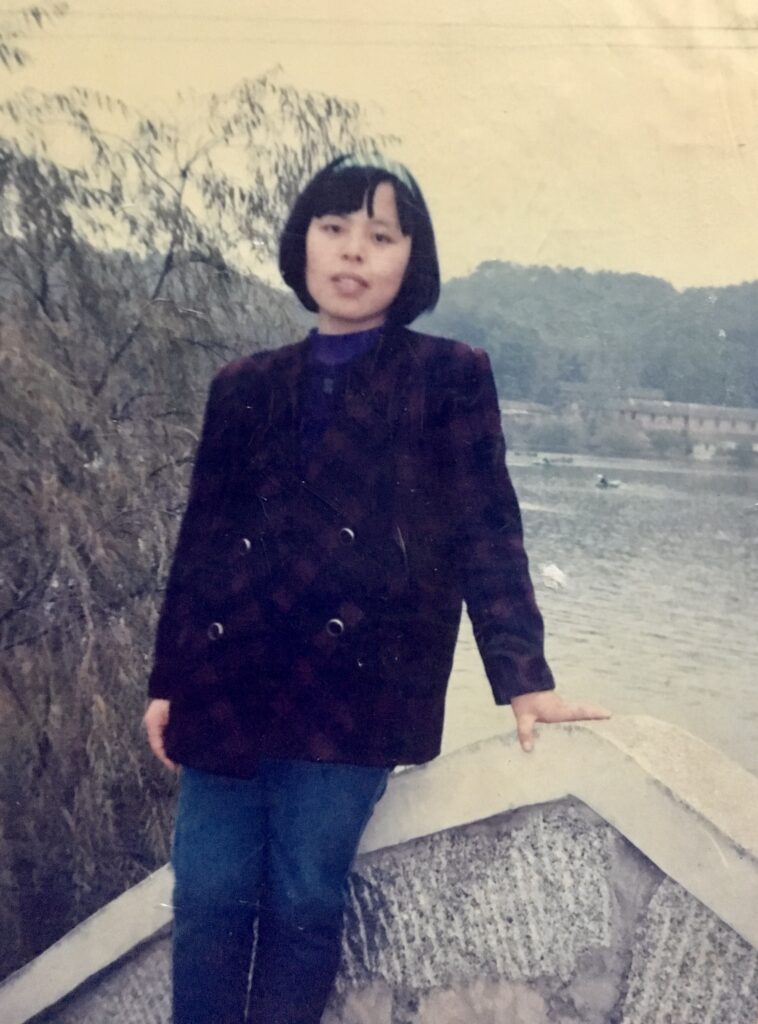
“I didn’t know what to answer. I have no idea what to do. So I was determined to study even harder and was really dedicated to my work. Later when I was interning at a hospital, other people all had breaks on weekends and holidays. But I’d never taken a day off. Everyday I woke up, didn’t do any make up or anything else, and just brushed my teeth and washed my face. As for my hair, I had really short hair so I just fixed it with my hands, and then I would buy some breakfast and go straight to the hospital to see the patients. I would take their blood pressure and temperature and finish all the cleaning in the office before my mentor came to work. And for this my mentor liked me so much! I would also ask for the patients’ symptoms before my mentor arrived so he would know all the detailed info, the medicine they were taking and if their symptoms had improved or not. Then when my mentor prescribed medicine, I would copy down whatever was in his prescription and study all the medicine and the related disease later at night. I stayed in the hospital until I was sleepy, and then I would go home and wash my face and go straight to sleep. There were many interns that didn’t go to work on Sundays, in the mornings and at nights. And I spent almost eighteen hours each day in the hospital. Even during my lunch breaks I would study the materials. So even though I had a weak start in my studies, after school and the two-year internship in the hospital, I gradually became good.”
Now one of the most sought-after doctors in Yiyang, Xian met her husband Guang through an acquaintance when she was in medical school. Initially, Xian wasn’t interested, thinking she knew other boys that were far more charming. She later agreed to date Guang after realizing he would do whatever she asked. Having witnessed the failed marriage of her elder sister and defended her against domestic violence, Xian said she had chosen Guang because he treated her nicely, despite his awkwardness in social settings.
“It is important for you to know when to give up on a boy in the future,” Xian told me after recounting the story of discovering her pregnant elder sister taking up all the work while her brother-in-law cheated with their home maid. “There are so many good choices out in the world. Don’t ever continue a relationship if that person treats you as if you were worthless, even if he is rich.”
Xian was fourteen when she first discovered her elder sister was experiencing domestic violence. They had been living on opposite sides in the same house, Xian and all her unmarried siblings taking up rooms on the north side, her elder sister and husband the south side. One day when she and her little sister were napping, Xian’s little sister shook her up, telling Xian their da jie(eldest sister) was having another altercation. Xian and her little sister stood outside the door of the south room and heard slappings. Pulling the door open immediately, Xian stormed into the room and confronted her brother-in-law.
“I was too little to fight him,” Xian told me. “But now I can definitely beat him down.”
During the years of her elder sister’s domestic turmoil as well as days after the divorce, Xian took care of her nephew and niece like they were her own children. Xian’s elder sister divorced her husband years after their second child was born, not long after Xian had her own son with Guang. When Xian’s water broke, she was still seeing a patient in the medicine store she owns until now. Xian told the patient to help call forth her family, and later gave birth to a boy named Maosui.
Maosui and I used to fight every time we saw each other when we were little. We fought over anything and everything. The remote control; the last piece of ham in the dish; the guest room bed in laowu. Laowu was the word for “old house” in our dialect. It used to be made of just dirt and wood, Xian told me. And the entire roof would shake with even the slightest storm. I had seen a picture taken of the house in its original form—the wall was coarse and yellow, barely distinguishable from the color of the dirt on the ground. Later when my uncle became an engineer and earned enough money to support the entire family, he had the house rebuilt.
“Every time we make constructions to the house someone would get sick,” Xian told me. “The house can’t be touched. One time it was me that got a high fever and had visions. And the other time was your uncle while he was rebuilding the house. He got so sick and he started to mumble things while having visions. The people constructing the house also fell sick on the site. Some of them were throwing up and the others suddenly became very weak.”
Familiar with Daoist arts and doctrines, my grandfather called a stop to the construction after having a sense of what might be going on. Not understanding how the house eventually got rebuilt, I was planning to ask when suddenly the fire alarm in my New York apartment set off, making me realize it was already fourteen past eleven at night in China.
We ended our interview at 11:16, after I insisted and told Xian it bothered me to have her go home so late at night. I told her to send me a message when she arrived home. A few minutes later, she sent me a video of her elder sister dancing to a pop song. Xian commented, “look how well your big auntie dances!”
I agreed and continued to finish the last half of my sandwich.

A person’s life is not a series of dramatic events for which he or she is applauded or exiled but a slow accumulation of days, seasons, years, fleshed out by the generational weight of one’s family and anchored by a land-bound sense of place.”
— Gretel Ehrlich, The Solace of Open Spaces
